Ceteris Non Paribus

Ceteris Non Paribus is my personal blog, formerly hosted at nonparibus.wordpress.com and now found here. This blog is a place for me to put the ideas I have, and the stuff I come across, that I’ve managed to convince myself other people would be interested in seeing. See the About page for more on the reasons why I maintain a blog and the origin of the blog’s name.

My most recent posts can be found below, and a list of my most popular posts (based on recent views) is on the right.

Ceteris Non Paribus

Can the UNODC's Murder Statistics be Trusted?

My parents came to visit me in Malawi back in December, and this did wonders for my mom’s level of concern about my welfare. She was able to see that Malawi at least looks relatively safe. We got to discussing safety and violence after the horrific murders of 20 kindergarteners that month. I made the off-hand claim that I am physically safer here than in the US. I’ve heard about awful crimes in both places, but I’m convinced in particular that my chances of being murdered are much lower here.

A couple of weeks ago I got around to looking that up to see whether the data confirmed my guess. I quickly found this Wikipedia page listing the intentional homicide rate for every country, which reports murder statistics from the UN Office on Drugs and Crime (UNODC). The UNODC figures assert that Malawi has an intentional homicide rate of 36.0 per 100,000 people, which is the twelfth-highest murder rate in the world. That’s a truly horrific figure, if true. It’s more than any US city save Detroit and New Orleans, but just 20% of Malawians live in urban areas.

I cannot possibly square that high of a murder rate with my experience here. I collected the data for my survey in Traditional Authority Mwambo, a rural area that conveniently has about 100,000 people in it. I was there for about 4 months, and during that time I befriended all of the local authorities, especially the police. In managing my research team, I was very cognizant of crime and our personal security, and pursued any and all rumors with my friends at the Jali and Kachulu police stations and at the local road traffic police as well. For their part, they were very open about the cases they were dealing with, and at one point the Jali police actually helped us find a different, more-secure place to stay out there. If Mwambo matched the national average, you’d expect 12 murders there over the course of four months. Even if the cities in Malawi had murder rates of 150 per 100,000, nearly triple the rate of the US city with the most murders per person, we would expect to see 7.5 murders a year and at least 1 or 2 over the course of 4 months. I heard about zero. I discussed a wide range of crimes, including some shootings, with local authorities there, but no homicides whatsoever.

Why am I writing about statistics from Wikipedia in the middle of the night? Because the Internet is serious business.

Data nerds such as myself like to talk about using the “smell test” on their results, and frankly this number just stinks every way I sniff it. Another way it smells is that nationwide, 36 murders per 100,000 people is about 100 murders per week. There are definitely murders reported in the Malawian press, but I would venture that I see about 1 or 2 per week, not 100. Alternatively, we can look at the distribution of all causes of death. Malawi has a death rate of 1350 per 100,000 people, so according to the UNODC murders cause 2.7% of all deaths in the country. That would mean that murder would rank above tuberculosis and ischemic heart disease in this ranking of the top ten causes of death in Malawi. Incidentally, it would also mean murder should itself be on that list, knocking off malnutrition.

The Wikipedia article has numerous caveats and hedges, including the suggestion that the data may include attempted murders as well as successful ones. However, it also has a link to the underlying table from the UN Office on Drugs and Crime. Annoyed by my inability to square the reported murder rate with other facts about Malawi, I decided to see where they were getting it from. In the footnotes, they attribute it to the World Health Organization Global Burden of Disease Mortality Estimates. After digging through the WHO website, I came to this page where one can download the datasets used for the Global Burden of Disease calculations. These are files that contain observations by year, country, gender, and disease, where disease is represented by an ICD code (there are different files for the ICD-7, ICD-8, ICD-9, and ICD-10 codes). If you know the ICD code you want you can look up total deaths as well as deaths by age bracket.

I didn’t get that far, though: none of the files have any entries for Malawi, and the data availability index doesn’t list Malawi data for any year. There is a country code for Malawi (1270) but it doesn’t actually appear to get used. I can’t say for certain where the claim of 36 murders per 100,000 people comes from, but I can tell you it’s definitely not from the WHO Mortality Database.

Now, any number of things could have gone wrong here. Maybe I took a wrong turn as I hunted for the WHO data the UNODC rely on, or overlooked something else obvious. It’s also possible that entries got miscoded, either in the UNODC or the WHO files, leading me astray. Or maybe there was private communication between those two UN offices, and the underlying data actually isn’t public.

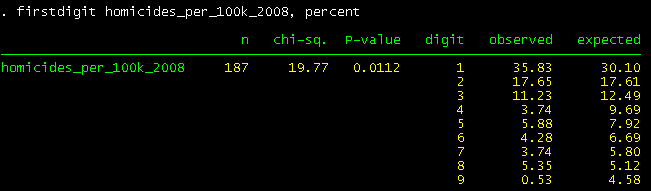
Fortunately, there are tricks I can use even when I can’t get my hands on the actual data. Back in 1938, Frank Benford observed that many datasets have the property that the leading digits of numbers (the “7” in “743”, for example) are logarithmically distributed, and death rates were actually one of the examples he leaned on in demonstrating what we now call “Benford’s Law”. If the law holds exactly, we’d expect 30.1% of leading digits to be “1”s, 17.6% to be “2”s, and so on, with a known, predictable percentage for each digit. And we can run a statistical test to see if deviations from the expected pattern are large enough to be meaningful, or are just random fluctuations. Using the firstdigit package in Stata, I ran this test on the UNODC spreadsheet’s mortality rates from 2008, which is the most-populated year in the table. As you can see, there are more leading “1”s than we’d expect under Benford’s Law, and across all digits the deviation from Benford is statistically significant at the 5% level – the p-value is 0.011, so we’re just barely above the cutoff to get 3 stars in a journal article.

firstdigit

It’s possible to delve deeper: what I’m really curious about is not all the statistics – it would be hard to get the ones for big countries like the US wrong – but specifically the figures attributed to the WHO Global Burden of Disease. If I break the data down into observations that list “WHO” as the source and everything else, only the WHO data looks suspicious (p=0.040), while everything else conforms reasonably well to Benford’s Law (p=0.214).* Or I can use the slightly-broader “PH” category for all public health-derived rates. Those look iffy (p=0.025) whereas the non-PH murder rates look alright (p=0.154). What’s more these aren’t just cases of large samples helping me to find spurious “statistically significant” effects: there are just 61 values coded PH in the data, and 187 overall.

The takeaway from that is that not just the Malawi murder but all the UNODC data supposedly derived from public health sources is questionable. I’m not trying to claim that these statistics were necessarily faked intentionally. I can imagine a number of ways they could have been screwed up by mistake. There might even be some reason why Benford’s Law would hold for some of these murder rates and not for others. Even if there was intent I have no idea who might have been responsible. What I am trying to claim is that they shouldn’t be taken seriously, or relied on for anything of importance, until someone can verify their source. And I do think this matters. People rely on these numbers, and draw judgments based on them. A glance at the top-ranking countries on Wikipedia’s list, would, for example, neatly confirm someone’s preconceived notions about Africa being a violent place. The top three African countries on that list are Zambia, Uganda, and Malawi – all have their statistics attributed to the WHO, and none actually appear in the WHO mortality data.

EDIT: I changed the Wikipedia article to remove the entries that I tried to trace down but could not find, until the source of the UNODC numbers is located or they are replaced with something better (Nameless has a suggestion in this post’s comments).

* I looked at all this a while ago but was just sitting on it until a recent Andrew Gelman post that cites the UNODC statistics prompted me to do something with it. I know Gelman wouldn’t like the fact that I’m leaning on p-values for the Benford’s law analysis, but I just don’t have any intuitive grasp of chi-square values.

Will cash transfers be better than subsidies for India's poor?

Adam Schwartz passes along this article stating that India is going ahead with plans to convert its myriad subsidies for the poor into a single cash distribution scheme tied to its biometric identity card system.

My knee-jerk response is that this is great: subsidies are distortionary, and fairly paternalistic. The premise is that elites or policymakers can better decide what the poor need than the poor themselves, which is a bit grating if you really think about it. While some might be more tolerant of India’s subsidies because they are designed by other Indians rather than by white people/foreigners/etc., I am definitely not.

The other perspective is that when people are given cash instead of an in-kind handout or a subsidy, they will spend it poorly – wasting it on stuff that’s useless or bad for them, like alcohol or tobacco. I’m pretty sympathetic to this view, too, and I don’t see it as contradictory to my dislike of paternalism. People may have reasonable goals that they can’t stick to, and subsidies can be a useful tool for committing their spending. There’s increasing interest in the possibility that these kinds of commitment problems are important in driving persistent poverty. One of my favorite papers, by Banerjee and Mullainathan, develops a very intuitive model that could explain this behavior. A counter-intuitive prediction of that model is that if the poor face the temptation to misspend, large lump sums of money may be preferable to getting the same amount of cash in small installemtns: rather than “burning a hole in your pocket, the large sum lets you buy something worthwhile instead of frittering away your cash on trivialties. On the empirical side, Kathleen Beegle, Emanuela Galasso, Jessica Goldberg, Charles Mandala and Tavneet Suri are working on a project that will randomly vary whether workers receive payments in lump sums or small installments. I’m also in the planning phases of a project with Lasse Brune that will look at this issue.

But understanding the fundamental determinants of consumption behavior is a pretty hefty task; even an optimist like myself must admit that it will take economists a long while to sort it out. Looking directly at cash transfer programs, however, we already know quite a bit. Evidence from various African contexts shows that unconditional cash handouts can have big benefits. One potential drawback is that they may reduce labor supply; since people tend to work for money, that’s easy to predict from even very simple economic models.

Tempering the large measured benefits of giving money to the poor, however, is the fact that many of those findings are specific to programs that target women. And lest we assume that, for example, the Zomba Cash Transfers project would have had the same benefits had it targeted men alone, work by my advisor and Hans-Peter Kohler suggests that while a cash windfall accruing to women leads to decreases in sexual risk-taking, the same windfall for men leads to rises in the amount of risky sex people have. The obvious inference is that this has to do with transactional sex: the men are able to buy it, the women able to avoid selling it.

It’s hard to say how this would play out in India. In some ways, gender inequities are far worse there than in Africa – while Africa does have “missing women”, for example, there is no evidence of the female infanticide nor of the deep favoritism toward young male children that is famously prevalent in much of India. On the other hand, my impression from visiting India is that transactional sex is not nearly as common there, which may be related to a culture that is prudish enough that some people still riot over public kissing. But the former issue is still a major concern – if men control this money moreso than the subsidies it replaces, and if women show less son preference than men, this program could do harm to girls that are already some of the most disadvantaged children on earth.

On balance, I think the shift to cash will do good on net. But this program is just crying out for a randomized phase-in process. There are legitimate questions about its impact, and the system lacks the capacity to roll it out to everyone at once. This is the textbook example of a case where a government should randomize the phase-in, say by locality, to see what the effects are. Unfortunately I don’t see any evidence that they’re planning to do that. And I’m sure this isn’t for lack of expertise – virtually any microeconomist would love to be able to access data on an experiment like that. I’ll even offer up myself: if Mr. Chidambaram happens to read this, I’ll gladly drop what I’m doing for a couple of days to set up a randomly-ordered list of the remaining districts where the scheme is to be rolled out. And I’ll do it for free!

Boxing Day Link Clearinghouse

A sprint toward the finish line for my dissertation fieldwork and a legally-mandated holiday in South Africa substantially cut down on my ability to post links and commentary here. So in the spirit of Boxing Day discounts, here are a eight great articles from the past month or so, for the price of one.

1) Some reassuring news from Slate: yes, your dog would eat your dead body. Of course your cat would do the same.

2) John Quijada invented his own language, built to be perfectly precise and free of ambiguity. It was co-opted by a cultlike group of Russians obsessed with perfecting their thoughts in order to perfect their bodies (shades of Dianetics) and things only get weirder after that.

3) An animation by Josh Blumenstock showing the movements of a single Rwandan based on the mobile phone tower she/he was using at any given time. From my own research, I am convinced that rural Africans are not only far more mobile than I would have assumed, but might move around more than Americans.

4) While riding the subway to a performance (!), Jay-Z humbly explains who he is to an adorable old lady, who turns out to be Ellen Grossman, an artist in her own right.

5) Alison of The Girl’s Guide to Law School takes law school deans to task for bullshitting prospective law students about many things, especially salaries. In so doing she points out something that I did not know: the distribution of starting salaries for lawyers is bimodal. This means that neither the arithmetic mean nor the median salary are particularly informative – the right way to think about this is that you have X probability of having a salary between roughly $25,000 and $80,000 (with an average around $50K), Y probability of having a salary of $160,000+, and (1-X-Y) probability of falling somewhere in between, where (1-X-Y) looks, to my eye, to be pretty small.

6) Tucked away at the end of this article on Malawian business groups complaining about the currency losing value against the dollar is the hilarious but distressing note that the Reserve Bank of Malawi’s publicist had to go to the media to explain that “depreciation or appreciation of the kwacha is as a result of market forces.”

7) Tom Pepinsky at Indolaysia points out the best explanation we have for shitty policies in Indonesia is shitty politicians, and that this theory is itself fairly shitty.

8) Faced with incessant complaints about wait times at its baggage claim, the Houston Airport responded by putting the baggage claim farther away, so that people spent the wait walking to the carousel rather than staring at it; complaints nearly ceased.

#1 via a comment thread on reddit, #2 via Melody Dye, #3 via Justin Schon, #s 4 & 8 also via reddit probably. #6 I stumbled across when doing research for my post on Malawi’s alleged foreign exchange shortage and couldn’t resist sharing.

Basi*

After two years of planning, and four months in the field collecting data, I finally wrapped up data collection for my dissertation this past Friday. Also, thanks to outsourcing my data entry to the awesome people at IKI, I’ve already started looking through the baseline data from the project. The followup data – which will reveal our actual results – is being entered right now, and I should have my hands on it sometime after Christmas. At that point, I’ll be able to look into my main research question, which is how people change their risky sexual behavior in response to the perceived risk of HIV infection. It is typical to assume that the relationship is negative – that the riskier an act is, the less people will do of it. However, there is little empirical support for this in the case of HIV in Southern Africa. In previous work I’ve argued that the relationship may be heterogeneous, with certain people responding positively instead. But whether this happens, and what the impact is likely to be, remains an open question. I will get to answer it in just a handful of days.

Until then, I’m enjoying a much-needed vacation in South Africa with my parents. See you on the other side.

*”Basi” is Chichewa for “enough”, and is used colloquially when you’re done chatting with someone – “Basi, ndapita” (Enough, I’m going).

The tyranny of "kwambiri"

A few weeks after I described my endeavors to figure out why people were always saying “which” (“ati”) around me, I managed to find the stem of the verb “kuti” in my hardcopy of Paas’s English-Chichewa/Chinyanja dictionary. This is evidently not just an aspect of Nyanja slang – it’s a legitimate word with its own entry. I’m going pay attention to see how much I hear it used in the central (Chewa-speaking) region next time I am up there.

Why did I have to learn the word through my field staff the first time? First off, the verb stem, “-ti”, is just two characters long, below the limit needed to search for it online. Second, kuti/-ti means at least half a dozen different things, depending on the context. Some examples:
1) Which (ati/liti/etc. with the prefix changing according to the noun class)
2) Where (kuti, “in which area/direction”/pati, “on which spot”/muti, “in which room”)
3) That (kuti)
4) Isn’t that right?
5) To say
6) To think

I got lead astray by definitions 1 and 4, when I wanted #5. A book I have called Chichewa Intensive Course by Fr. N. Salaun actually has a whole section dedicted to the various meanings of kuti in its verb form alone:IMG_1358

Homonyms are pretty common in Chichewa. One of my employees likes to say thatit’s not a rich language, but that’s a narrow view. Even if the vocabulary is limited (I don’t know enough of the language to be able to say) the grammar certainly is not. The construction of verbs is rather elegant, and various verbs, adjectives and nouns are related in subtly elegant ways. To pick one example, “kugula” is “to buy” and “kugulitsa” is “to sell”.

However, there is one cluster of homonyms in Chichewa that is definitely an area where the language is limited, and is fairly confounding to me as a researcher. I am referring of course to “kwambiri”. It means both “a lot” and “very much”. But colloquially, either it or the adjective “-mbiri” seem to be the most common way to say “more”, “the most”, and “too much”. To pick one example of how this has tripped me up, it has meant that when I was writing survey questions for a project about vaginal drying practices, we couldn’t distinguish between a woman’s vagina being “very wet” and “too wet”, which is kind of central. On another survey, we had to totally rephrase questions about people’s most preferred time to receive income.

I’d imagine this is similar to Spanish speakers trying to translate survey questions that rely on “ser” and “estar” (which are two different senses of “to be”) for into English. Direct translation is often possible, but sometimes things are virtually untranslateable. It also speaks to a broader issue with surveys done in other countries: the fact that your survey questions have been copy-edited, field-tested and validated means almost nothing, because the actual questions your respondents will answer are the translated versions, and those will often be very different.

There is no such thing as a foreign exchange shortage

Malawi is currently in the throes of yet another lovely fuel shortage. This is great timing for me, as I am currently in a mad rush to finish data collection for my project on how people’s beliefs about HIV transmission rates affect their sexual behavior.

It’s also maddening because it brings out all kinds of fallacious reasoning about markets and economics. One claim I’ve heard is that shortages like this one are just a standard thing that happens in Africa and/or poor countries. That is easily falsified by the fact that Malawi’s black market in petroleum products is supplied by people going right across the border to Mozambique (a different poor, African country), where fuel is abundant.

No, this shortage, like the others that preceded it, is caused by a price ceiling (or, to be fair, a system of several different price ceilings covering multiple markets). The details are a bit messier than an Econ 101 price ceiling graph like this one from Wikipedia, but it’s a decent first approximation.

ceiling

I might go into the ludicrous details of fuel markets in Malawi in a future post (and indeed I might write an entire research paper on the topic). That’s a topic for a different rant. This one is about an alleged shortage of foreign exchange, which is the most commonly-cited reason for the fact that I can’t buy gasoline. That is certainly not the cause of the country’s intermittent fuel crises, because there is no such thing as a foreign exchange shortage.

The claim is that there is not enough foreign exchange (“forex”, in the colloquial Malawian English) – that is, dollars – in the country to buy sufficient fuel on the international market to meet demand. Now, there is a sense in which this is true: dollars are hard to come by in Malawi. And this is a story which the government typically likes – a “forex shortage” sounds like an exogenous event like a drought or a plague of locusts, visited upon a blameless country by angry gods. Last year the government blamed forex shortages on donors, who had pulled their funding from the country.

But we need to go beyond the fact that dollars are hard to find in this country, and ask why that is true. To be precise, they aren’t really that hard to find. Plenty of people have them around. Rather, they are hard to buy – last year, in the throes of the alleged forex shortage, there were official waiting times of several years to buy dollars at the official, legal rates. Because it is illegal to pay a price for dollars at which their owners are willing to sell them. The exchange rate between dollars and Kwacha has nominally been floating since this spring. That should mean that you can pay whatever you want for dollars, but the float is evidently closely managed. The newspapers are again full of stories of “black market” foreign exchange purchases. There are official exchange rates available at banks, and that is what you are allowed to pay. These do change gradually, but for at least the past three weeks the actual transacted exchange rate has been 320 Kwacha to the dollar (I observe this rate whenever I withdraw money from my US bank account, because my bank* kicks ass and just gives me the market-middle rate). It is illegal to pay a higher price to obtain dollars. If you do, and you are caught, the state will use its monopoly on violence to take away your money and possibly imprison you.

Dollars are only hard to buy at the artificially-low price the government has set for them. Couldn’t they be hard to find at any price? That’s extremely unlikely, if not outright impossible. Suppose I had twenty dollars, which are supposedly worth MK6400. I’d be unlikely to sell them at that price. What if you offered me ten times that? One hundred? At some price, I’d be able to buy more than twenty dollars worth of stuff in Malawi and sell it elsewhere. This will hold as long as the local currency has any value whatsoever. Even hyperinflation doesn’t overcome this argument: yes, the value of a hyperinflating currency will drop incredibly rapidly, potentially sending my purchased currency toward zero dollars of value even as I try to spend it. But I can simply raise the price even higher to compensate for that fact. In any case, that is far from the situation here in Malawi. The exchange rate should probably be around 20-30% higher, and if it were you could buy all the dollars you wanted.

Now, I’m not trying to argue that floating exchange rates have no problems, or make any policy recommendations at all, really. My point is merely that the current situation is in fact a policy choice. I can understand why the government chooses to frame it differently, though. “There’s a shortage of forex” sounds like a reasonable explanation for the country’s problems, and it definitely seems to be perceived as something outside the control of the government. “We set a binding price ceiling and nobody is stupid enough to sell dollars at a legal price” would be a tougher sell to the public. But it has the virtue of actually being true.

*The bank in question is Charles Schwab Investor Checking. Among their many other virtues, they allow their customers to use any ATM in the world for free, and actually reimburse any fees charged by the ATM. The downside is that they don’t have physical locations, so you can’t go talk to a teller about your feelings (or deposit cash). I won’t link to their site since it would be hard to prove that I’m not getting kickbacks from them, but I swear that they are actually awesome and not paying me to promote them. It’s worth noting that I’m not a very successful marketer: I’ve been touting them at every opportunity for years with almost no success.

Racial confusion

Most folks in Mwambo haven’t seen many white people before. This usually just means that the kids are at once excited and terrified when I show up. But that’s not the only amusing consequence of their lack of exposure to my kind: they also often have no idea exactly what I am. About 30 to 40 percent of children assume I must be Chinese, or maybe that Chinese and white people are the same thing. So they shout “Chaina” at me, which I guess is the word for a Chinese person, and also repeat things I said in a Chinese accent, throwing in some “chings” and “chongs” for good measure. I actually consider it kind of an honor – who knew I could pass for Asian? – but it would be pretty offensive were I actually Chinese.

Today, a woman out near Lake Chilwa did even better. As I passed by in the project minibus, she shouted “Colored!” at me. In Malawi, “colored” is used the way it is in South Africa, as a term for people of mixed white and African heritage. In the US, such a person would just be considered black, due to the persistence of “one drop of blood”-style reasoning.

Now, I don’t actually look the least bit black. One of my enumerators suggested that the confusion might have arisen from my baseball cap, which shaded my face slightly. But considering my generally dismal failures in attempting to blend in, or at least not be too obtrusive, I see this as a small victory.

Things the US could learn from Malawi: local government

Admitting this never wins me too many friends, but I’m not a huge fan of democracy in and of itself. Don’t get me wrong, the empirics indicate that it leads to better results than other systems, much of the time. When that’s true, I’m a big fan, but I don’t see much intrinsic value in having elections. At the end of the day, what matters to me is that the roads are in good shape and the streetlights are on at night and that people have freedom of conscience and speech, not that there are free and fair elections.

Sometimes democracy simply doesn’t work[]. It’s been a while since I pretended at being a political scientist, and even then I had little exposure to domestic US politics, but my anecdotal view is that local politics are pretty much a catastrophe in America. People don’t vote in local elections, unless there’s an important headline race to draw them in, and they have no idea who their local representatives are. Creationists are able to sneak their candidates onto school boards in order to try to strip evolution out of textbooks.

Not only don’t elections for local government in the US seem to work, I’m not convinced that local government itself does a very good job. For one thing, it’s never all that local: the lowest level of government still covers many thousands of people. There is no government official in Ann Arbor that has any idea who I am. I could fix that by befriending people at government buildings, I guess, but what matters is the principle. The actual policy outcomes seem pretty bad too. When I lived in San Francisco, they had a system of parking permits that created a sharp discontinuity on my (non-permitted) block, driving everyone else without permits to park there. The City of Ann Arbor recently shut down the largest thoroughfare through town to build a parking lot. For two years. Another recent accomplishment was the City Council’s attempt to block a development by declaring some houses on my block to be “historic Germantown”.* This gambit resulted in the building of a fairly hideous structure that neither the developer nor the council wanted.

Fine, those are pretty bad outcomes. Does Malawi really do better, at the local level? Given the context, I would argue that it does. Malawi’s lowest level of government is still the unelected headmen* who run individual villages. In much of Southern Malawi, village headmanship is inherited through the mother’s bloodline, just like ethnic affiliation; some men in line to be a village head will take their mother’s surname (which I believe is how things were always done before the British showed up) in order to strengthen their claim. Village heads exercise power through control of land, which they are free to allocate to people from their village. Villagers can claim title to the land they are working by paying a fee to the government to lease it, but this is usually uncommon.***

Village heads don’t tend to have any real budget to work with, so the role of local government in Malawi is pretty different from e.g. Ann Arbor’s city council. A lot of what they do is to serve as conduits for the dissemination of information and the implementation of government and NGO programs. They are tapped to organize the distribution of Malawi’s fertilizer subsidy coupons, for example, and to nominate needy individuals to receive food aid. One aspect of this is that village heads tend to know people and local geography really well. The sampling strategy for my current data collection effort relied on finding out the basic details on every person in every household in each of the 70 villages in the study. There’s no way we could have pulled that off without the help of well-informed village heads; we actually did visit a couple of villages with out-of-touch chiefs and it was a big pain. We rely on village heads in other ways, too: when stories spread that we were coming at night to steal people’s blood, they provide the best way of spreading accurate information to fight those rumors. There are tons of important things that probably could not happen without the aid of these most local of local officials.

I’m not the only researcher who has come to this conclusion, either – it seems to be pretty common for people who have done fieldwork in Africa to have a high opinion of village heads. When Tristan Reed presented his paper “Chiefs” at WGAPE this past spring, many of the political scientists in the room leapt to the defense of village heads, worried that the paper would be used as ammunition by people who dislike them. (It shows that public goods provision drops when there are fewer checks on their power, but also that a measure of “social capital” goes up, implying that some heads are capturing local social structures).

This view is challenged by recent work by Mansuri and Rao, who show that development aid is more likely to be wasted or stolen if channeled through local governments than national ones. But that’s not the right comparison, really – the question is whether we can do better. Would an elected local government be less corrupt? Are local goverment officials in the US more above-the-board than village heads in Malawi? We don’t know much about the answer to the former question, at least in Malawi. As for the latter, if you’re leaning toward “yes”, there are several million Chicagoans who would like a word with you. Corruption sucks, but I’m not convinced that moving to village-level elections would fix it, and am worried about losing some of the practical benefits of hereditary village heads in terms of logistics and social networks.

*I never once noticed these historically-important buildings until they were torn down.
**And often headwomen (to break with the traditional sense of “-man” meaning a person of either gender in a particular profession.) Malawi has a sizable number of female village heads, who are often referred to as “mfumukazi”, an amalgam of the words for “chief” and “woman”. People in this position are often called “chiefs”, but that term rubs me the wrong way for the same reason that I’m not a fan of “tribe”. Malawians don’t seem to find the term odd at all. The best term is probably the gender-neutral “village head”, so obviously no one ever says that.
***My source for much of this is informal conversations with locals and so the specifics might be different.

Great news for Malawian agriculture

A recent study in Zambia and Malawi has found that growing Gliricidia trees on maize farms boosts yield by 50%. This happens because the Gliricidia trees fix nitrogen from the air and, as I understand it, some of it comes out from their roots, benefiting the maize; this is a substitute for fertilizer. This could be a boon to Malawi especially, since the country’s program of fertilizer subsidies is increasingly hard for the government to afford.

Peter Aagard’s comments are thoughtful but I think maybe incorrect – he points out that you can’t just look at the agronomic benefits of planting the trees; this is an economic problem, and it must be both profitable and affordable within household’s credit constraints: “Researchers tend to focus on the agronomic benefits of technologies, while ignoring whether they are actually doable by labour-constrained households.” Labor constraints are a legitimate concern, but in general Malawian farmers are anything but labor-constrained. For a large part of the year (including most of the 5-odd months I’ve been here this time) they have nearly nothing to do. They are labor-constrained around planting and harvest time (and maybe in between, too, I’ve never been around during that period). The key question is whether those short periods when labor is at a premium overlap with the two or three times per year you need to prune the trees. If not, this innovation seems eminently affordable.

Valuing communities over individuals

aidnography is critical of the way One Laptop Per Child has presented the results of an experiment where they dropped off Android tablets in a village in Ethiopia, and the kids quickly learned to use them. They reasonably point out that saying “I thought the kids would play with the boxes” feels a bit elitist or even racist. No question.

But then they go farther. The penultimate paragraph begins “The biggest question I have is whether through ‘dropping off laptops’ children will really be learning skills that are valuable for their community, helping them making their community more resilient.” That seems like a reasonable standard, no argument here. However they continue: “and also helping them to stay in the local area.” Slow the hell down. “Helping people stay in the local area” is an awful goal for a development program. If they want to, of course they should stay put, but the idea that we should push people toward staying put is somewhere between foolish and offensive. As I’ve argued before, meaningful development is impossible unless people leave the countryside. And what if we had focused on helping Oklahomans stay in the local area during the 1930s? The best-case scenario is that the US would still have an enclave of incredibly poor subsistence farmers in Oklahoma. The worst case is a famine. Or imagine the mass death that would have occurred if the Irish hadn’t been allowed to leave their home country during the mid-19th century.

This attitude comes from treating communities as if they were sentient beings with rights and feelings, and, even worse, that their rights and feelings supersede those of actual people. I find this approach so alien and confusing that it’s almost incomprehensible, since it seems to imply that we should feel bad if a village ceases to exist, even if all the people from that village moved on to nicer areas and better jobs.

Hat Tip: Development Impact